.webp)
ISO 3632 is the international standard used to define and test the quality of dried saffron, including whole filaments, cut filaments, and powder.
It allows buyers to compare batches using measurable laboratory results rather than relying only on appearance, origin claims, or commercial grade names.
What Is ISO 3632?
ISO 3632 is the global standard used to define and test the quality of saffron. It applies to saffron in different forms, including whole filaments, cut filaments, and powder.
Two saffron batches may look similar but perform differently in production. ISO 3632 helps buyers compare their colour, flavour, aroma, moisture, and purity through measurable laboratory results.

ISO 3632-1:2025 vs ISO 3632-2:2010
ISO 3632 has two main parts, and buyers in the wholesale saffron trade should understand the difference.
- ISO 3632-1 defines the specifications. It explains the quality requirements and classification framework for saffron.
- ISO 3632-2 defines the test methods. It explains how laboratories should test saffron consistently, including sample preparation, microscopy, moisture determination, UV-Vis spectrophotometry, and artificial colouring detection.
What ISO 3632 Measures in Saffron
ISO 3632 focuses on measurable quality indicators. The three best-known values are colouring strength, flavour strength, and aroma strength.
- Colouring strength is mainly linked to crocins and is measured around 440 nm. This value shows how strongly the saffron can release colour.
- Flavour strength is linked to picrocrocin and is measured around 257 nm. This value helps indicate the bitterness and characteristic taste profile of saffron.
- Aroma strength is linked to safranal and is measured around 330 nm. This value helps buyers evaluate saffron smell and understand whether the batch has the expected aromatic character.
ISO 3632 also looks at moisture and volatile matter, floral waste, foreign matter, ash values, water-soluble extract, and possible artificial colouring.
The Three Main Lab Values: Crocin, Picrocrocin, and Safranal
These three laboratory values help buyers compare the colour, flavour, and aroma performance of different saffron batches using measurable test results.
Crocin: Colouring Strength
Crocin-related colouring strength is one of the most important commercial values in saffron testing. On a COA, it may appear as colouring strength, colouring power, or crocin value.
For food production, this number matters because stronger colouring can improve dosage efficiency. A stronger saffron batch may require less saffron to reach the same visual result in rice, dairy, beverages, confectionery, sauces, or ready-to-eat products.
A visually red batch does not automatically mean strong colour performance. The crocin-related value is what helps confirm actual colouring strength.
Picrocrocin: Flavour Strength
Picrocrocin is linked to saffron’s characteristic flavour. On a COA, it may appear as flavour strength, bittering strength, or picrocrocin value.
This value matters for products where saffron is not only used for colour. Premium food products, beverages, supplements, and wellness formulations often depend on saffron’s flavour profile as part of the final product experience.
If the picrocrocin-related value is weak, the saffron may still colour the product but fail to deliver the expected taste.
Safranal: Aroma Strength
Safranal is linked to saffron aroma. On a COA, it may appear as aroma strength, odorous power, or safranal value.
Buyers should not ignore this number. Very low aroma values may suggest poor drying, aging, weak storage conditions, or loss of volatile compounds. Unusual values may also need sensory review or additional testing.
In practical terms, crocin shows colour performance, picrocrocin supports flavour evaluation, and safranal helps assess aroma quality.
Compare current wholesale rates by saffron type and review available offers on our global saffron price page.
How ISO Categories Relate to Agroota Saffron Types
ISO categories and Agroota saffron types are related, but they are not the same thing. ISO 3632 Category I, II, and III are based on lab-tested values such as colouring strength, flavour strength, aroma strength, moisture and purity. Agroota saffron types describe the saffron’s physical form, trimming level, appearance, and common market use.
For buyers, the easiest way to read the relationship is:
ISO Category I
Usually aligns with Agroota’s highest-potency, all-red saffron types.

- Best Agroota matches:
- Royal Negin
- Super Negin Saffron
- Negin Saffron
- Coupe / Sargol Saffron
Why:
- These types are usually all-red or highly trimmed.
- They are selected for strong colour, flavour and aroma performance.
- They are more suitable for premium export, private-label saffron, gourmet retail, nutraceuticals, cosmetics and high-end food production.
- Agroota describes Royal Negin as consistently testing as ISO 3632 Grade I, and Super Negin as exceeding ISO 3632 Category I.
Coupe is also described by Agroota as exceeding ISO 3632 Grade I thresholds.
ISO Category II
Usually aligns with Agroota’s mid-range saffron types.
Possible Agroota matches:
- Pushali A saffron
- Stronger Pushali B saffron batches

Why:
- These types may still have good saffron character.
- They may include more style or have lower performance than fully trimmed all-red types.
- They can work well for food production where cost efficiency matters.
- They are usually better for buyers who need authentic saffron but do not need the highest visual or lab performance.
ISO Category III
Usually aligns with lower-potency or more traditional saffron forms.
Possible Agroota matches:
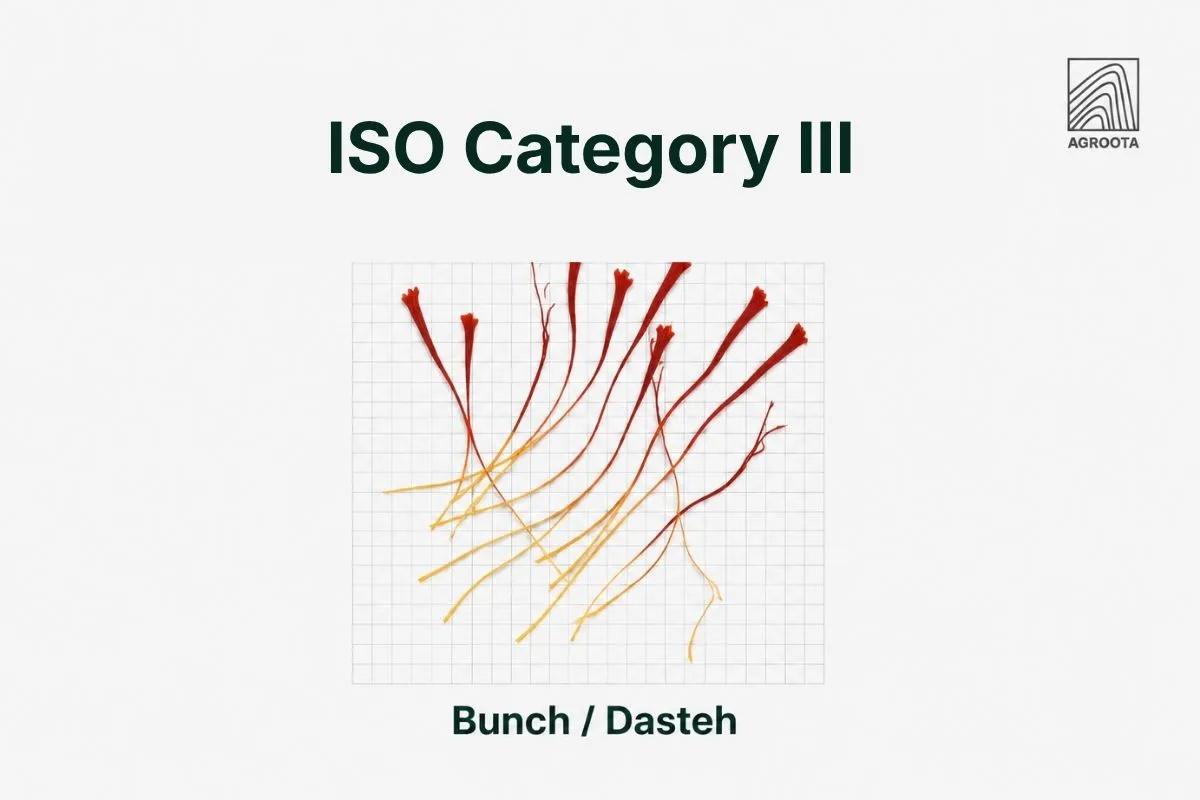
Why:
- These types usually include more yellow or white styles.
- They have lower active compound concentration per gram.
- They may require a higher dosage to achieve the same colour or flavour effect.
How ISO 3632-2 Tests Saffron in the Laboratory
ISO 3632-2 is especially useful because it explains the laboratory route behind saffron testing. It is not just a grading label. It is a testing framework.
.webp)
A proper ISO 3632 saffron test may include several laboratory checks, such as:
- Identification test
- Microscopic examination
- Moisture and volatile matter determination
- Floral waste determination
- Foreign matter determination
- Water-soluble extract determination
- Total ash and acid-insoluble ash testing
- Crushing and sieving, where required
- UV-Vis spectrophotometric analysis
- Artificial colouring detection by TLC or HPLC
For buyers, this matters because a serious COA should not only show three attractive numbers. It should show that the batch was tested through a recognized method and that the results belong to the exact sample being sold.
Why Sample Form Matters: Filaments, Cut Filaments, and Powder
ISO 3632 testing does not treat every saffron form in exactly the same way. Whole filaments, cut filaments, and powder require different preparation and verification steps.
This is important for buyers because powder is harder to inspect visually. With whole threads, the natural stigma structure can still be examined. With powder, the shape is destroyed, so the risk of hidden fillers or blended material is higher, which can affect colour performance, aroma, and saffron taste.

This does not mean saffron powder should never be used. Powder can be practical for industrial food production, beverage formulation, standardized dosing, and ingredient blending. But powder should be purchased with stronger documentation, especially batch-specific ISO 3632 testing and additional purity checks when needed.
For high-value powder orders, buyers should consider microscopic analysis, artificial dye screening, and advanced methods such as HPLC when authenticity risk is high.
Microscopic Examination: What the Lab Looks For
Microscopic examination helps identify saffron-specific plant structures and detect floral waste, starch grains, pollen, foreign plant fragments, or other unusual particles. It is particularly useful for crushed saffron and powder, although it should be combined with other methods for full authenticity verification.
Moisture and Volatile Matter: A Critical Quality Indicator
Moisture affects saffron's weight, shelf life, storage stability, and shipping risk. Excess moisture may increase the effective cost of the product and contribute to mould, microbial concerns, or quality deterioration. Buyers should therefore verify the moisture and volatile matter values on the batch-specific COA, especially for shipments passing through humid climates.
Floral Waste and Foreign Matter
Floral waste and foreign matter are different quality concerns.
Floral waste refers to parts of the saffron flower that are not the valuable red stigma. These materials can increase weight without improving colour, flavour, or aroma performance.
Foreign matter refers to material that should not be present in the saffron sample. This may include non-saffron plant material, dust, fragments, or other impurities.
Both matter in wholesale trade because saffron is expensive by weight. Even small percentages of unwanted material can affect cost, performance, and buyer trust.
Ash and Acid-Insoluble Ash
Ash and acid-insoluble ash are purity indicators in saffron testing. They do not show saffron colour, taste, or aroma strength, but they help detect unwanted mineral residue in the sample.
Total ash shows the overall mineral residue after controlled burning. Acid-insoluble ash helps point to contamination such as sand, soil, dust, or other inorganic particles.
UV-Vis Spectrophotometry in Saffron Testing
UV-Vis spectrophotometry measures the absorbance of saffron extract at 257 nm, 330 nm, and 440 nm to evaluate flavour, aroma, and colouring strength. These results should be linked to the specific batch being offered.
Artificial Colouring Detection
Artificial colouring is one of the major concerns in saffron fraud. Low-quality material may be dyed to appear stronger, fresher, or more visually attractive.
ISO 3632-2 includes methods for detecting certain artificial water-soluble acidic colourants, including thin-layer chromatography, known as TLC, and high-performance liquid chromatography, known as HPLC.
For buyers, this is important because visual inspection is not enough. A dyed sample may look impressive in photos but fail laboratory screening.
Artificial colouring checks are especially important when the price is unusually low, the colour looks unnatural, the supplier cannot provide batch-specific documentation, or the product is sold as powder.
.webp)
Buying for the Indian market? Check the current saffron price in India per kilogram, review available Delhi stock, and request a live wholesale quote.
Why Saffron Powder Needs Stronger Verification
Saffron powder is commercially useful, but it carries a higher adulteration risk than whole threads.
Once saffron is ground, buyers cannot inspect the natural filament structure. Fillers or cheaper materials can be hidden more easily. Possible adulterants may include turmeric, paprika, starch, safflower, marigold, dyed plant material, old saffron powder, or other non-saffron materials.
For this reason, bulk saffron powder should be purchased only with strong documentation. A buyer should request ISO 3632 testing, microscopic examination, artificial dye screening, and additional authenticity checks when the order value or risk level justifies it.
If a business does not specifically need powder, whole filaments are usually easier to verify.
What a Proper Saffron COA Should Include
A useful saffron COA should connect the test results to the exact batch being sold. A generic certificate is not enough.
A useful saffron COA should be traceable to the exact batch or lot being offered and include:
- Laboratory name
- Test date
- Batch or lot number
- Sample form: filaments, cut filaments, or powder
- Test method or ISO reference
- Colouring strength
- Flavour strength
- Aroma strength
- Moisture and volatile matter
- Foreign matter
- Floral waste
- Ash values, where available
- Artificial colouring screening, where available
- Any notes that may affect interpretation
The batch number is especially important. If the COA cannot be matched to the physical batch, it should not be treated as proof of quality.
ISO 3632 Is Not the Same as an ISO-Certified Supplier
ISO 3632 testing is not the same thing as saying a supplier is ISO certified.
A supplier may have ISO 9001 or another management-system certification. That may say something about the company’s quality management process, but it does not prove that a specific saffron batch was tested under ISO 3632.
For saffron quality, buyers should ask for a batch-specific COA with actual tested values. The certificate should prove the quality of the product being offered, not only the supplier’s general business credentials.
Common Saffron Quality Problems ISO 3632 Can Help Reveal
ISO 3632 cannot detect every possible fraud or safety issue by itself, but it can help expose many weak, diluted, or suspicious batches.
Common problems include:
- High moisture
- Weak colouring strength
- Low aroma strength
- Excess floral waste
- Foreign plant material
- Artificial colouring
- Poor powder authenticity
- Batch mismatch between COA and shipment
- Recycled COA from another lot
One warning sign does not always prove fraud. But when the price, COA, appearance, aroma, and supplier story do not match, the batch should be retested before purchase.
ISO 3632 Is Essential, But It Is Not Enough
ISO 3632 is a strong baseline for saffron quality verification, but it should not be the only protection layer for serious bulk buyers.
It helps measure colour, flavour, aroma, moisture, and selected purity indicators. However, some buyers may need additional testing depending on the market, application, and order value.
Additional tests may include:
- HPLC
- LC-MS
- FTIR or NIR fingerprinting
- Microscopic examination
- Pesticide residue testing
- Microbiological testing
- Heavy metal analysis
- Mycotoxin testing
For food brands, importers, and distributors, the right testing plan depends on destination-market requirements, product use, supplier history, and risk level.
How ISO 3632 Helps Buyers Compare Saffron Price
ISO 3632 helps buyers understand why two saffron batches may have different prices even if they look similar.
In wholesale trade, price should not be judged only by origin, thread size, or product description. Lab values matter.
A batch with stronger colouring strength, acceptable aroma, good flavour indicators, low moisture, and clean purity results may cost more per kilogram but perform better per gram in production.
This is why the cheapest saffron is not always the most cost-effective saffron. A weak batch may require a higher dosage, create inconsistent product colour, or cause quality-control issues later.
For U.S. orders, review the latest saffron price in the USA per kilogram and pound, along with available domestic stock and import-ready batches.
Final Takeaway
ISO 3632 helps wholesale buyers compare saffron through measurable laboratory results rather than appearance or supplier claims. Before confirming an order, buyers should verify that the COA matches the exact batch and includes the relevant quality, moisture, purity, and test-method information.
Frequently Asked Questions
What is ISO 3632?
ISO 3632 is the international standard used to define and test saffron quality. It helps laboratories measure important indicators such as colouring strength, flavour strength, aroma strength, moisture, and purity.
What does ISO 3632 measure in saffron?
ISO 3632 measures saffron quality through values such as crocin-related colouring strength, picrocrocin-related flavour strength, safranal-related aroma strength, moisture and volatile matter, floral waste, foreign matter, ash values, and artificial colouring indicators.
What is the difference between ISO 3632-1 and ISO 3632-2?
ISO 3632-1 covers saffron specifications and classification. ISO 3632-2 covers the test methods used by laboratories to measure saffron quality consistently.
Why is crocin important in saffron testing?
Crocin-related colouring strength shows how strongly saffron can release colour. This is important for food brands and manufacturers because stronger colour performance may reduce the amount of saffron needed per production batch.
Why is saffron powder riskier than saffron threads?
Saffron powder is harder to inspect visually because the natural filament structure is destroyed. This makes it easier to hide fillers, old saffron powder, artificial colouring, or other non-saffron materials.
Is ISO 3632 enough to prove saffron is safe?
Not always. ISO 3632 is useful for quality verification, but buyers may also need pesticide residue testing, microbiological testing, heavy metal analysis, mycotoxin testing, or advanced authenticity testing depending on the market and product use.
What should buyers check on a saffron COA?
Buyers should check the laboratory name, test date, batch number, sample form, ISO test method, colouring strength, flavour strength, aroma strength, moisture, purity indicators, and artificial colouring results when available.
Looking to Source Saffron in Bulk?
Compare saffron types, review available batches, and source wholesale saffron for your business based on current supply availability.
Need Current Bulk Saffron Pricing?
View indicative wholesale saffron price ranges by type, or learn how Agroota helps businesses source saffron in bulk.


.svg)